

We started with the body. Nature showed us the rest.
Responsible science, intentional design, inspired by nature.
Everything is a wave.™
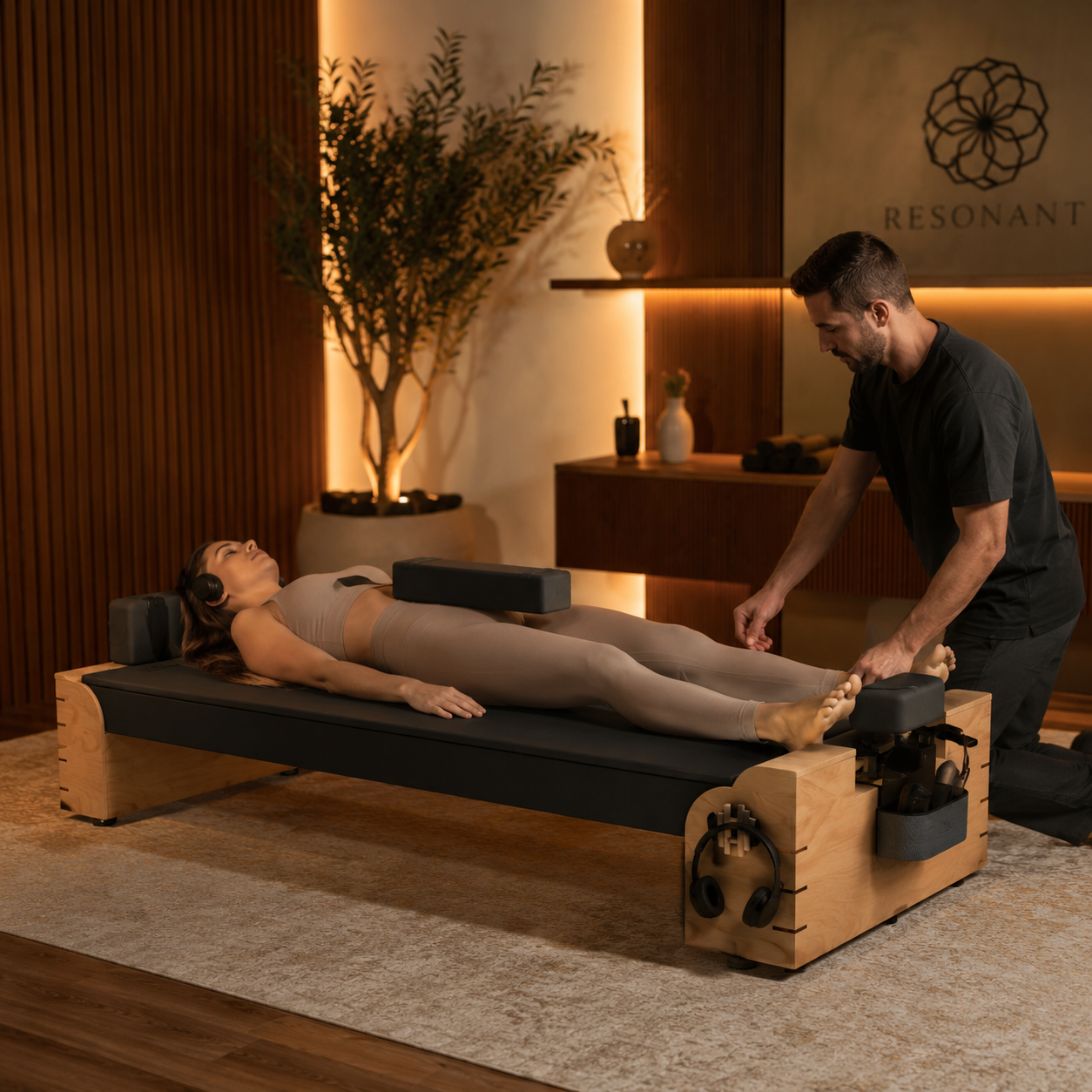
Sound travels through air as a wave, and the same kind of movement travels through a solid as vibration. Hearing and touch are the two senses that receive movement directly. ResonantVibe built VAVE to carry sound and vibration to both, composed to arrive as one event.
In the founder's words
Kaveh Ershadi, founder.
I have worked as a biomedical engineer for twenty-four years, studying the human body and the nervous system and building systems to measure and to deliver for human use. That is a plain way to describe a road that ran through three countries. A bachelor's degree in biomedical engineering in Iran. Two master's degrees in France, one in medical imaging with a focus on designing clinical and research protocols, and one from the École des Mines in biomedical engineering and design, focused on building standardized, safe systems for human use, and on medical device development and design. Then Houston, and twelve years in nuclear medicine, developing and implementing targeted therapies. Twelve years of watching a novel field earn its place by measuring what it did is what convinced me that a nervous-system-first approach needed the same rigor, and that nobody was giving it that.
Nature showed me the foundation: everything is vibration. Of all the senses, two receive movement directly: hearing and touch. Hearing has the finest temporal and frequency resolution of the senses, and it is what tells one thing from another. Touch is the body's largest sensory surface, and it is what a whole platform can reach. Those two are the foundation I chose to build on. So I started studying vibration: how to deliver it, where to deliver what, and how to make it safe.
The field came next. Vibroacoustics has been in use for forty years, and it is still young in evidence. Not because it does not work, but because it has never had a standard instrument. An independent review of the field, published in 2022, said the published work was too sparse to tell which properties of the stimulus matter, and asked researchers to report, at minimum, frequency, amplitude, pulsation and loudness. Studies reported what was sent to the amplifier, not what arrived at the body.
And there was something the field was not looking at. The nervous system does not only read the signals. It reads the relationship between them: how the sound and the vibration sit together, where each one arrives, and when. There is no magic frequency. What matters is the relationship, and nobody was designing for it. So I designed MRFT, Multisensory Relational Frequency Technology, a technology for composing to several senses at the same time, by sense and by place, the way nature does.
I looked at the systems available and the literature behind them, and wrote down what a system would have to be: safe, repeatable, multisensory, effortless, measurable, modular, adaptable, and accessible. I could not find it anywhere. So I built it. That is where ResonantVibe begins, in Denver, Colorado, where it still is.
The name
VAVE began as an acronym, VibroAcoustic Vitality Enhancer, the working name of the first platform, written on the first drawings. The acronym is history now; the name stayed. The name is not a claim about what a session does for you, and we do not use the name as one.
What we believe
A systemic problem needs a systemic solution, and nature is the one system that already has it: an ecosystem, fully immersive, arriving through everything at once. That is the model: a whole environment received by the whole body, rather than one sense, one signal, one lever.
We did not invent any of this. The patterns were already there: in sand on a driven plate, in the way a wave carries you rather than strikes you, in what a fluid shows that a solid hides. And people were working with sound and vibration for thousands of years before anyone could measure a single thing about it. Those people were learning from nature as well; they watched, and listened, and kept what held up. We have the same teacher and one more instrument. So we will not tell you that thousands of years of practice prove anything about our platform. They observed. We also measure.
Responsible is the harder half. It means saying what we can show and not what we would like to be true. Publishing the measurement whichever way it comes out. Correcting ourselves in public. Declining the claims that would help us most.
Intentional design is the standards written before the build, and every part of the equipment chosen with one question in mind: how to build without harming what taught us, and how to waste as little as we can.
Inspired by nature is demonstration, not metaphor: sand for the wide view, water for the close one, and the picture tells you what to build.
Four teams, and a research arm that does not answer to sales.
Our product design team chooses materials and designs the process with that question in mind. Our music team spends hours on the platform composing MRFT sessions for each category and each format. Our wellness team spends months learning how to bring MRFT into a somatic practice, and works with engineering, music and design to make every session safe, and worth lying down for. And our research arm, RESONAID, in formation, designs studies of our own premise, registered before data collection, results published either way.
We are here to pioneer this category, by making it measurable and accessible.

FAQ


Denver, Colorado. Sessions and demos happen at events, conferences and pop-ups through Resonarah.
RESONAID is under common ownership and in formation as an independent sponsor, and it is the only place study data goes. ResonantVibe builds the instrument; RESONAID studies it and publishes either way. We keep the two apart on purpose.
The name came first. The platform is built to carry a signal, not to resonate, and the longer answer is on our Clarifications page.